Appling Leads Spartans Past Pilots

Image
Photo by David Defever

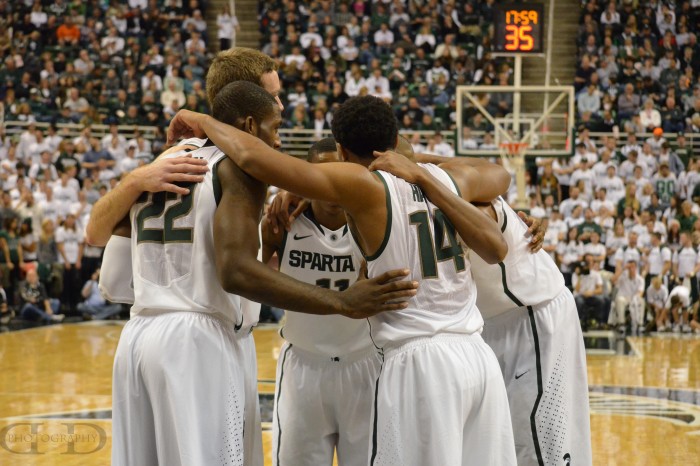
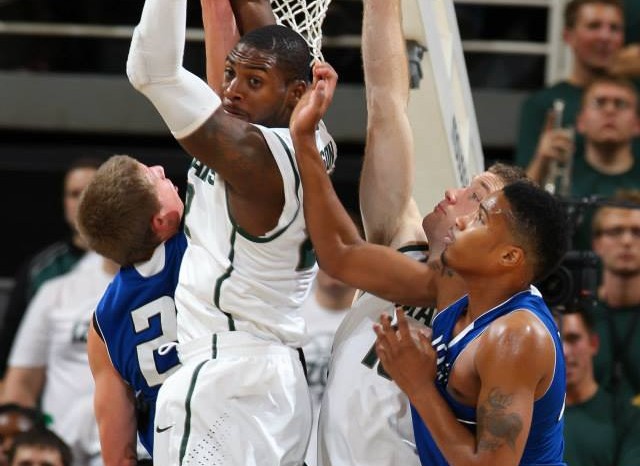
NOV 19, 2013 – The Spartans squared off against the Portland Pilots on Monday night as part of the Coaches vs. Cancer Classic. After surviving a scare against Columbia on Friday, Coach Izzo decided to shake up the starting lineup.  Gauna and Denzel Valentine started in place of Branden Dawson and Matt Costello. Dawson had eight points and seven rebounds against Columbia, and Costello failed to score in only 10 minutes of action.

Both teams traded blows during the entire first half, with Michigan State taking a seven-point lead with just over six minutes to play. Portland then went on a 9-1 run to take the lead with just over three minutes remaining in the half.

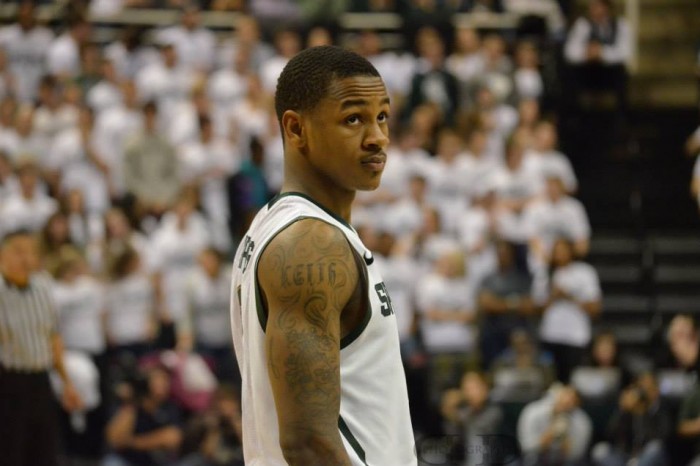
Back-and-forth play ensued, with the Spartans never being able to pull away from the Pilots. MSU held on to a slim four-point lead at halftime, largely due to the hot hand of Keith Appling. The senior scored 16 points on 4-4 shooting from beyond the arc, all in the first half.

In the second half, the Spartans finally started to pull away. After back-to-back threes by Gary Harris, MSU took a 10-point lead with just over nine minutes remaining in the game.

State wouldn’t look back after that, eventually extending their lead to 18 with 3:52 left. Appling continued his hot streak, scoring nine second-half points for a total of 25. The Spartans went on to win the game 82-67.

Appling’s 25 points tied his career high. Izzo said it was “one of the greatest point guard performances in many many years.”

Keith responded well after a disappointing three-point performance against Columbia. Izzo said he thinks Appling is becoming a leader, but just needs to work on communication. He went on to say that Appling is not the same player from last year. Hopefully he can continue his hot streak into conference season.

Adreian Payne scored 19 points and grabbed seven rebounds. With Costello and Gauna playing a combined 19 minutes, Dawson was forced to play much of the game at the power forward position. He was effective on the boards, with a team-high 10 rebounds. Dawson also had a huge impact on the offensive side, with numerous offensive rebounds and tip-ins.

The Spartans need to figure out who is going to anchor the five position. Gauna got the start, but was only used sparingly. Costello was effective when he was on the court, grabbing five rebounds in 10 minutes. It will be interesting to see how Izzo will handle the rotation going forward.

Although the Spartans won by 15, they did not look like the No. 1 team in the nation. Izzo jokingly said that he doesn’t have to worry about peaking in November. The Spartans head to Brooklyn on Friday and Saturday for the Coaches vs. Cancer Championship rounds.

– See more at: http://impact89fm.org/sports/2013/11/20/appling-leads-past-pilots/#sthash.B0SQCm8A.dpuf

Scouting Report: Columbia Lions

NOV 14, 2013 –

The Columbia Lions visit the Breslin Center on Friday night at 9 p.m., as part of the Coaches vs. Cancer Classic. Here is a quick rundown on the Lions as they prepare to take on the Spartans:

Head Coach: Kyle Smith (42-45, fourth season)

Last Season: 12-16

This season: 1-1

Key Players: Grant Mullins, Cory Osetkowski

The Columbia Lions come into this game as heavy underdogs. The Ivy Leaguers have virtually no chance against a soon-to-be number one ranked Michigan State team. Head coach Kyle Smith has done fairly well in his tenure at Columbia. 12-16 may be considered a disappointing season for a Big Ten team. But for a small school like Columbia, they are pleased.

Last year, the Lions were giant killers, knocking off two eventual NCAA tourney teams in Villanova (75-57) and Harvard (78-63). Columbia finished last in the Ivy League with a 4-10 record. However, they gave up the second fewest points in the Ivy League.

Two key players to watch out for are sophomore Grant Mullins and Cory Osetkowski. Mullins is the team’s leading scorer, averaging 18 points per game. He’s shooting at an amazing 69% from the field and is 5-9 from behind the arc. At 6’3”, he will most likely be matched up against Gary Harris. Junior Osetkowski is the tallest player on the Columbia roster at 6’11”. He’s averaging 12.5 points and seven rebounds per game this season. Matt Costello or Adreian Payne will most likely draw this matchup. I don’t expect either player to struggle defensively or on the boards against Osetkowski.

This season, the Lions are 1-1. They came out victorious in their first game against Maryland-Eastern Shore 73-54. Their second game they fell to mighty Manhattan 71-70.

Columbia might seem like a weak matchup for Michigan State, but the Spartans are coming off a huge win over Kentucky. Too often, teams have letdown games after a huge victory, which could be Columbia’s only chance of winning. They are overmatched in every single position and don’t have nearly the depth of MSU. The Spartans proved on Tuesday that they deserve to be the number one team in the nation, and absolutely dominated the Wildcats. The game should have never been as close as it ended up being, which further proves how good MSU really is.

There is no telling what the Spartans will do to the Ivy League cellar-dwellers. This game could get ugly.

– See more at: http://impact89fm.org/sports/2013/11/14/scouting-report-columbia-lions/#sthash.zagRW3Nm.dpuf

Pistons Recap: OKC and Portland

NOV 12, 2013 – The Oklahoma City Thunder came to the Palace of Auburn Hills on Friday for the first and only time this season.

The Pistons held on to a slim two-point lead after the first quarter, mostly due to 10 points by Josh Smith. But Kevin Durant and the Thunder charged back, taking an 11-point lead late in the second quarter. Less than two minutes into the third quarter, the Pistons tied the game back up at 56.

It was a game of runs, with one team racing out to a lead, then the other coming right back. A late third quarter run capped off by a Jeremy Lamb three-pointer at the buzzer gave the Thunder an eight-point lead. The Pistons were not able to overcome that deficit and ended up losing 119-110.

Durant led all scorers with 37 points on 9-15 shooting and 17-19 from the charity stripe. Russell Westbrook added 20 points and Serge Ibaka had 11 with nine rebounds. Rookie center Steven Adams looked impressive coming off the bench, scoring 17 and grabbing 10 boards. The Thunder dominated the inside, outscoring the Pistons 50-40 in the paint and also outrebounding the Pistons by 10. The Thunder move to a 4-1 record with the win.

Greg Monroe continued his hot streak, posting another double-double (20 points, 15 rebounds). Smith had perhaps his best game as a Piston, scoring a team-high 25 points and adding eight rebounds. Brandon Jennings seems to be over his injury and looked like the guard we saw in Milwaukee. He scored 22 points and dished out 11 assists. Rodney Stuckey came off the bench and scored 17 points.

Even though the Pistons are a big, physical team, they can also got out in transition with the best of them. They outscored a very athletic OKC in the fast break 25-12.

The Pistons then embarked on their four-game west coast road trip, starting in Portland. The Pistons have historically struggled in the west, going 1-43 in their last 44 road games against the Western Conference. They looked to change their fortune against the hot Trail Blazers.

Damian Lillard’s nine first quarter points helped the Blazers jump out to a four-point lead at the end of one. Midway through the second quarter, the Pistons came back and took a 43-42 lead on a Rodney Stuckey three-pointer. But the Blazers continued their hot shooting and eventually took a three-point lead into halftime. The Blazers controlled the third quarter, never giving up their lead. With 1:28 left in the fourth quarter, the Pistons charged right back, coming within four points after a Jennings layup. But the Pistons failed to score another point, and went on to lose 109-103.

Lillard had a hot hand the whole night, going 5-8 from beyond the arc and scoring 25 points. The frontcourt tandem of Robin Lopez and Lamarcus Aldridge combined for 35 points and 22 rebounds. Their defense, however, was a little suspect. They allowed the Pistons to score 60 points in the paint, compared to just 36 for the Blazers. Portland moves to 5-2 on the year.

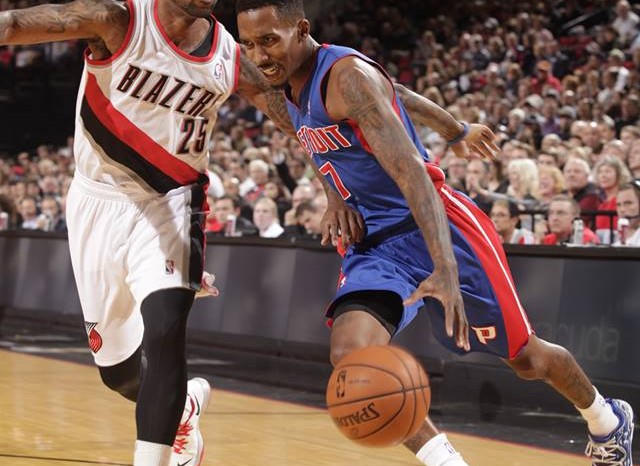
Brandon Jennings did all he could to keep the Pistons in the game, scoring 28 points, including 13 in the fourth. Andre Drummond bounced back from an off night against the Thunder, scoring 16 and grabbing 16 rebounds. All of his points came in the paint. Greg Monroe continued his hot streak, scoring 19 points and snagging eight rebounds. Josh Smith scored 11 and Stuckey added 13 points off the bench. The Pistons fall to 2-4 on the season, including three losses in a row.

The Pistons move on to Oakland Tuesday to square off against Golden State at 10:30 pm. The game can be seen on Fox Sports Detroit, and heard on 97.1 the Ticket.

– See more at: http://impact89fm.org/sports/2013/11/12/pistons-recap-oklahoma-city-and-portland/#sthash.09eaHAKp.dpuf

Scouting Report: Kentucky Wildcats vs. Michigan State Spartans

Nov 10, 2013

Head Coach: John Calipari (124-26 at Kentucky, 5th season)

Last Season: 21-12, Lost in first round of NIT to Robert Morris

2013-14 record: 2-0

Key Additions: Julius Randle, Andrew Harrison, Dakari Johnson, James Young, Aaron Harrison, Marcus Lee (All in ESPN Top 100 Prospects)

Key Losses: Nerlens Noel, Archie Goodwin

John Calipari worked his recruiting magic once again this year. He landed six five-star recruits this year. That’s unheard of in college basketball (except at Kentucky, they do it just about every year). It’s likely that four of these recruits will make the starting lineup (Randle, Young, Harrison twins), which means that they’re vulnerable early in the season. A lack of experience and team chemistry could outweigh their extreme amount of talent.

It’s tough to gauge how this year’s team will fare because of how different it is from last year’s disappointment. The 2012-13 team entered the season ranked number three in the nation and failed to make the NCAA Tournament. They ended up losing in the first round of the NIT to Robert Morris. Their star big-man Nerlens Noel tore his ACL in February and missed the remainder of the season. After that loss, Kentucky wasn’t the same team.

Willie Cauley-Stein, the only returning player projected to be in the starting lineup, averaged 8.3 points and 6.2 rebounds last year. Alex Poythress will most likely be the first off the bench for the Wildcats this year. The sophomore averaged 11.2 points and 6.0 rebounds per game last season.

The Wildcats are undefeated in their first two games of the season, beating UNC-Asheville 89-57 on Friday and Northern Kentucky 93-63 on Sunday. Julius Randle, arguably the most talented player on the team, is averaging 22.5 points and 14.5 rebounds through the first two games. Marcus Lee added 17 points off the bench in the first game, but only scored five in the second.

How will the Wildcats match up against the Spartans? Lets take a look:

Pos.

Kentucky Projected Starters

Michigan State Projected Starters

C

Willie Cauley-Stein (So, 7’0”, 244 lbs.)

Adreian Payne (Sr, 6’10”, 245 lbs.)

F

Julius Randle (Fr, 6’9”, 250 lbs.)

Matt Costello (So, 6’9”, 240 lbs.)

F/G

James Young (Fr, 6’6”, 215 lbs.)

Branden Dawson (Jr, 6’6”, 225 lbs.)

G

Aaron Harrison (Fr, 6’6”, 218 lbs.)

Keith Appling (Sr, 6’1”, 185 lbs.)

G

Andrew Harrison (Fr, 6’6”, 215 lbs.)

Gary Harris (So, 6’4”, 210 lbs.)

Julius Randle will be a handful for MSU’s frontcourt. He has been on a tear thus far (although against subpar competition). He can score at will and is a beast on the boards. The Harrison twins have a big size advantage over Harris and Appling. Look for them to be physical and take it to the rim against smaller defenders. The Harrisons are averaging a combined 23.5 ppg compared to 31 points for the Harris/Appling combo.

The most intriguing matchup will be Dawson against Young. Both are the same height but Dawson has a 10-pound advantage. Dawson scored 12 points and grabbed 12 rebounds off the bench against McNeese State. Coach Izzo held him out of the starting lineup because he was late to a team meeting. Dawson should return to the lineup on Tuesday. Young is averaging eight points and 2.5 rebounds per game. If Dawson can consistently hit jumpers in the 15-foot range, he could become a nightmare to defend.

The Spartans obviously have a huge advantage when it comes to experience, which could prove to be the difference. Look for MSU to pressure the Wildcats early and try to rattle the young players. With Kentucky being so athletic, MSU has to be careful in transition. If this game goes down to the wire, which it most likely will, MSU will be the cooler team. Kentucky isn’t used to pressure situations. Most of their players have never played in a close college basketball game.

Bottom Line: The Spartans will come away with a hard-fought victory 84-79. The game will come down to free throws, and the Spartans will come up clutch in that department.

The game is on Tuesday, November 12 in Chicago at the United Center. Tipoff is at 7:30 p.m. on ESPN and heard on the Spartan Sports Network.

– Original link to article: http://impact89fm.org/sports/2013/11/10/scouting-report-kentucky-wildcats-vs-michigan-state/#sthash.fNvx1dXB.dpuf

2013-14 MSU Basketball Season Preview

Nov 8, 2013 – McNeese State will kick off the action for the Spartans on Friday before they head to the Windy City to take on John Calipari and the Kentucky Wildcats. But before the season begins, all of the experts have weighed in on how the Spartans will fare. Here’s a sampling of what they had to say about the green and white.

Bleacher Report recently published a list of the top 100 players in college basketball. They had four out of five of coach Tom Izzo’s starters on the list: Branden Dawson (88), Keith Appling (33), Adreian Payne (22), and Gary Harris (9). They also released their Big Ten predictions, putting MSU at the head of the class and Adreian Payne as the Big Ten Player of the Year. However, they have the Ohio State Buckeyes winning the B1G Tournament in Indy.

ESPN released their annual preseason poll, ranking MSU No. 2, behind Kentucky and in front of defending national champion Louisville. In a separate article, 18 out of 20 experts had the Spartans making the Final Four, with six writers predicting them to cut down the nets in Jerry-World Dallas in April. Three experts said that Tom Izzo would be Coach of the Year, and nobody picked a Spartan for Player of the Year.

CBS Sports released their preseason All-American teams, with Adreian Payne being the only Spartan selected, making the third team. Their top 25 slated Michigan State at No. 3, trading positions with Louisville. Their preseason bracketology gives Michigan State the No. 1 seed in the Midwest region, with Kentucky, Kansas, and Duke claiming the other three No. 1 seeds. For their Big Ten preview, the Spartans are again predicted to finish first. Gary Harris and Adreian Payne made the preseason All-Big Ten team, with Harris also picked as the preseason Player of the Year. Izzo was selected as the Coach of the Year as well. Their top 100 players list included Gary Harris (7), Adreian Payne (15), Branden Dawson (56), and Keith Appling (82).

According to CBS Sports, Las Vegas released their odds on several different categories in college basketball. For the National Championship, they gave MSU 9-1 odds, fifth best in the nation. For Player of the Year, they gave Adreian Payne 14-1 odds (ninth best) and gave Gary Harris 50-1 odds (13th best). They gave MSU 2-1 odds to win the Big Ten, tops in the conference.

Overall, everyone seems to be high on the Spartans this year, as expected. The season would be considered a disappointment if Sparty didn’t make the National Championship game. This is one of the deepest Michigan State teams that Izzo has been fortunate enough to coach in years, with four NBA prospects on the team and experience everywhere.

The Spartans will get a chance to prove themselves early in the season, facing No. 1 ranked Kentucky on Tuesday in Chicago. Izzo also scheduled North Carolina (12th in the AP poll, 11th in the ESPN/USA Today poll) on December 4 at home, and unranked Georgetown on Super Bowl Saturday at Madison Square Garden. This matchup might be the most intriguing because of its timing. Most coaches don’t schedule non-conference games in the middle of conference play, but Izzo isn’t most coaches. The Spartans have never been afraid of stiff competition in their non-conference schedule. Just last year, they played Connecticut, Miami, Texas and Kansas all before they started Big Ten play.

Froling’s Prediction: Michigan State will finish first in the Big Ten during the regular season and will win the tournament. Branden Dawson will be the most improved player, Gary Harris will be the Big Ten Player of the Year and finish in the top-five in the voting for Naismith Player of the Year, along with Adreian Payne, but Creighton’s Doug McDermott will take Player of the Year the honors. The Final Four in Dallas will include MSU, Kansas, Duke, and Ohio State, with MSU losing to Kansas in the Championship Game.

– See more at: http://impact89fm.org/sports/2013/11/08/2013-14-season-preview/#sthash.YTNlVTC0.dpuf

Logjam in Backcourt Hurts KCP, Bynum

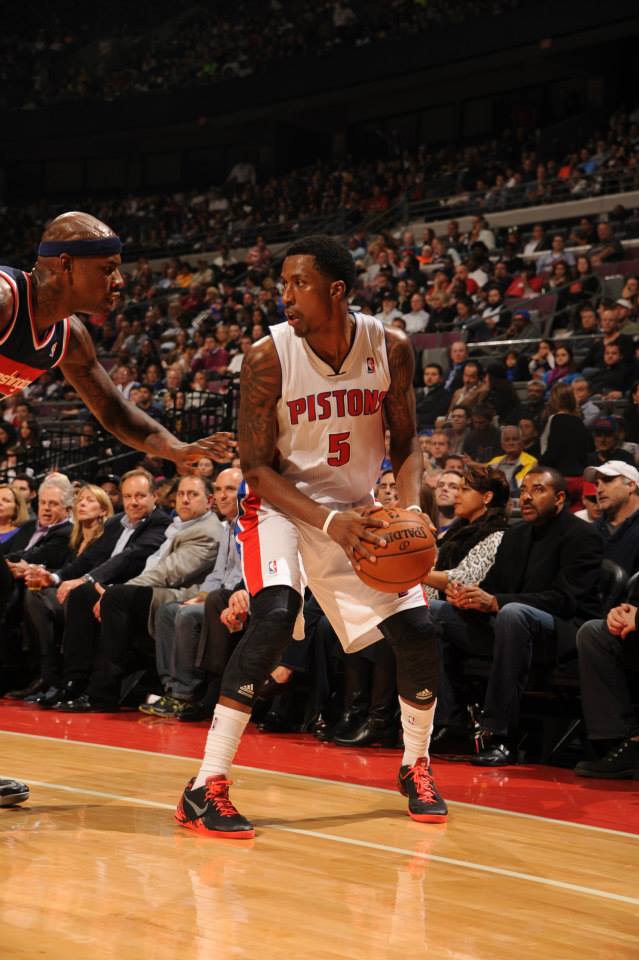
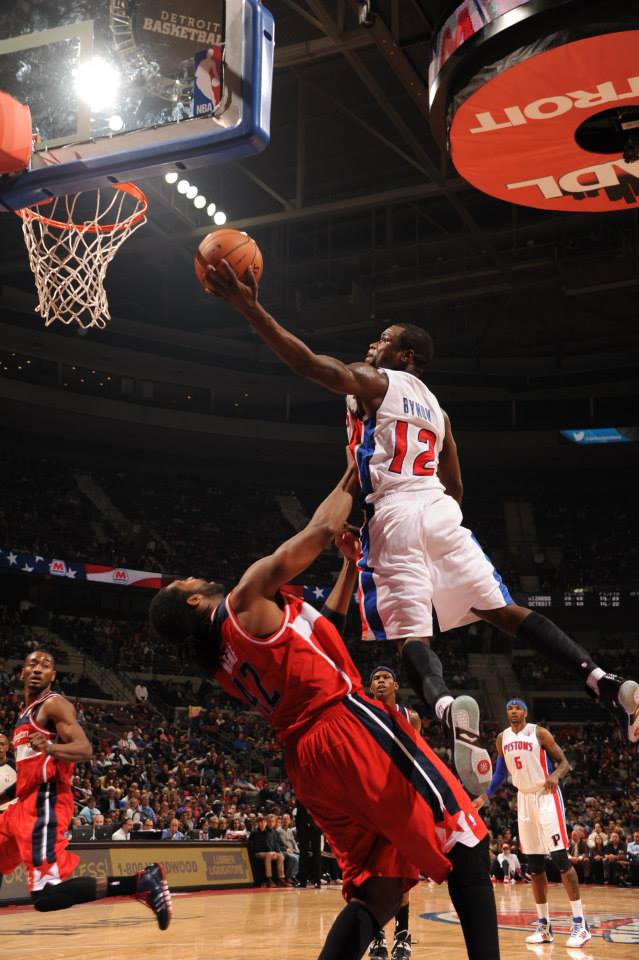
Nov 7, 2013 – With the recent return of guards Rodney Stuckey and Brandon Jennings, the Pistons find themselves in a sticky situation. Currently they have five guards on their roster, all of which have performed well when given the opportunity.Stuckey, Jennings, Chauncey Billups, Will Bynum, and rookie Kentavious Caldwell-Pope (KCP) all have had their bright spots this season and look to contend for minutes. But five guards are too many to rotate through in one game. Someone has to sit out or take a significant cut in minutes. So far, the player affected most has been KCP.

In the first two games of the season, KCP averaged over 22 minutes on the court. He scored 13 points in only 18 minutes in a loss to Memphis. He added nine points in 27 minutes in the season opener versus Washington, in which both Stuckey and Jennings were inactive. With the return of both guards, there was just nowhere for coach Maurice Cheeks to place the rookie.

In the last two games against Boston and Indiana, KCP played zero and four minutes, respectively. Barring more injuries, it appears as if this will be a trend for KCP, unless Cheeks decides to give Billups games off for rest. Another option would be to move Pope to the small forward position. At 6-foot-5, it might be a bit of a stretch, but his shooting abilities make him well suited as a wingman.

The other guard that could see his role diminish is Will “The Thrill” Bynum, who started the first three games of the season alongside Billups. In his first two games, Bynum averaged 18.5 points and 5.5 assists. But when Jennings returned to the lineup against Boston, Bynum saw his minutes nearly cut in half.

In the two games Jennings has been active, Bynum only scored a total of nine points. The only way Bynum could see his minutes increase would be if Billups was given a night off or if Cheeks decided to move KCP over to the small forward position for a game.

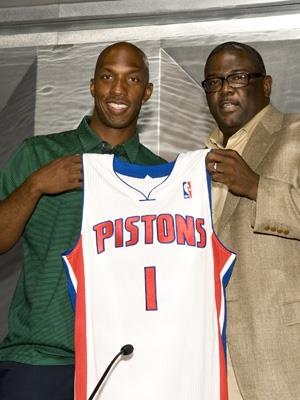
Chauncey Billups has started every game for the Pistons so far this season. Although he’s seen his minutes slightly diminish in the last two games, it was expected. When he was signed in the offseason, the plan was for Chauncey to come off the bench and play 20-something minutes per game.

With all the injuries in the backcourt, Billups has been thrust into a starting role. Cheeks will likely shuffle the starting rotation as the season goes on, with Stuckey being the most likely to take the starting position from Billups.

The logjam at the guard position is a problem, but one that Coach Cheeks doesn’t mind having. This team is one of the deepest Pistons squads in years, and it will help in the dog days of the season. Players will be fresh, but not rusty. Being a former player himself, Cheeks knows how to handle the rotation, especially at the guard position.

For the remainder of the season, look for Jennings and Stuckey to get the bulk of the playing time in the backcourt, with Billups first off the bench. KCP will continue to get DNP’s next to his name, but could also sporadically see significant minutes to give someone rest. Bynum will see about 20 minutes of action per night, and will start a handful of games going forward.

– Original link to article: http://impact89fm.org/sports/2013/11/07/logjam-in-backcourt-hurts-kcp-bynum/#sthash.MaAljruJ.dpuf

Pistons Weekend Recap: Memphis and Boston

Nov 5, 2013 – After an impressive opening night win against Washington, the Pistons packed their bags and headed for the birthplace of rock ‘n’ roll to face the Memphis Grizzlies on Friday. Memphis had just lost their first game of the season in San Antonio, and was looking to bounce back against the new-look Pistons.

Detroit had not beaten Memphis since October 28, 2009. With Rodney Stuckey returning to the lineup, the Pistons added much-needed depth to their backcourt.

With 1:08 left in the fourth quarter, Josh Smith hit a three-pointer to give Detroit a six-point lead. But the Grizzlies charged back, tying the game with eight seconds left on a Marc Gasol layup. A missed three-pointer by Chauncey Billups sent the game into overtime.

The Pistons played catch-up the entire overtime period. Zach Randolph and Tony Allen took advantage of Pistons miscues and opened up a 106-97 Grizzlies lead with 1:30 left. The Pistons never had a chance after that, eventually losing 111-108.

Josh Smith had 19 points on a paltry 7-23 shooting, including 3-11 from beyond the arc. Smith was much more effective when he drove to the basket, making four of his seven shots in the paint. Andre Drummond logged 48 minutes, the most of any player on either team. Drummond finished with an impressive stat line, posting 12 points, 16 rebounds, three steals and two blocks with only one turnover. Greg Monroe had an equally impressive night, scoring 16 and grabbing eight boards.

Rookie Kentavious Caldwell-Pope added 13 points and Rodney Stuckey scored 19 off the bench. Will Bynum, once thought to be the odd man out in the Pistons’ backcourt, started alongside Billups and scored 18 points on 7-11 shooting. With Brandon Jennings returning to the lineup in Boston, it will be interesting to see how Head Coach Maurice Cheeks rotates his guards.

On the Memphis side, Mike Conley led all scorers with 22 points and five steals. Frontcourt duo Zach Randolph and Marc Gasol combined for 31 points and 18 rebounds in the contest. Memphis had never won a home opener since the team moved from Vancouver in 2001.

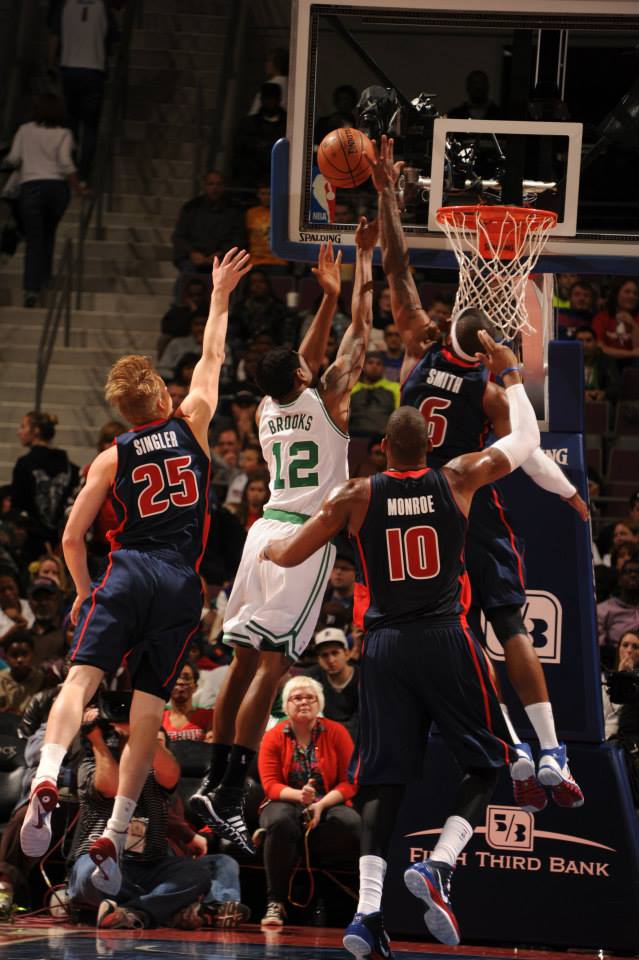
The Pistons then headed home on Sunday, where they wore their new “Motor City” jerseys. They plan to wear them during every Sunday night game this season. Their opponent was the Boston Celtics, a franchise in rebuilding mode.

The Pistons dominated the paint the entire game, outscoring Boston 54-38 down low. Detroit opened up a 10-point lead in the first half and seemed in control of the game. But the young Boston team rallied back, taking a 64-63 lead early in the fourth quarter. A few short minutes later, the Pistons went on a run of their own, extending their lead back to 10. The Pistons never looked back, going on to win 87-77. The Celtics dropped to 0-3, while the Pistons moved to 2-1 on the season.

Smith, Drummond, and Monroe combined for 45 points and 29 rebounds, while Drummond had his way with the Celtics, dunks and put-backs galore. Brandon Jennings made his regular season debut after returning from tooth and jaw problems and was forced to wear a mask but was still able to score 14 points and dish out four assists.

The Pistons stay in Detroit this week,  facing Paul George and the Indiana Pacers on Tuesday and Kevin Durant and the Oklahoma City Thunder on Friday.

Original link to article: http://impact89fm.org/sports/2013/11/05/pistons-weekend-recap-memphis-and-boston/#sthash.2YjllrN0.dpuf

Opinion: Branden Dawson is the Spartans’ X-Factor

Branden Dawson’s freshman season ended during the final regular season game of the year versus Ohio State, when he tore his left anterior cruciate ligament. That injury changed the trajectory of Dawson’s career. Instead of spending the summer of his sophomore year developing his game or possibly preparing for his rookie season in the NBA, he was forced to rehab his knee.

 Dawson saw his production drop in his sophomore campaign, going from 16.4 points per 40 minutes pace adjusted to 13.7. Although he was healthy, the mental aspect of recovering from such a serious injury still lingered.

“The mental aspect was hard. When I came back from my ACL injury, there were times where I was thinking too much, and there were times where I went in for a dunk and I just went in and just laid it up. The mental aspect, it was very tough on me. I was going out there, and I was thinking a lot,” Dawson said in an interview with Spartan Nation Radio.

This prevented Dawson from having the breakout season everyone expected from him. If he hadn’t injured his knee, he would probably be in the NBA right now, but a slight letdown of a season made Dawson think twice about making the leap to the pros.

Now entering his junior year, Dawson says he is “100 percent now,” and is due for that breakout year. This is why he will be the Spartans’ x-factor. Without having to worry about his knee, Dawson was able to spend his summer working on his game, especially his jump shot. Although he shot 53% from the field last year, that number was down four percent from his freshman campaign. Branden Dawson has not made a three point shot in a Michigan State uniform, but this year looks to be different. He is so proud of his new jump shot that he posted a video on his instagram account of him shooting.

http://instagram.com/p/cfAR1LGiRj/

Dawson has improved so much over the summer that coach Tom Izzo had this to say about the junior in an interview with Spartan Nation Radio:

“This summer he’s improved his shot. He’s improved his body. I think he’s had the best summer of his life, and I think he’ll be ready for hopefully a breakout junior year.”

Everybody can talk about how important Adreian Payne, Gary Harris, and Keith Appling will be for Michigan State this year, but Branden Dawson might be the player that could carry the team from very good to the best in the nation. With an improved jumper and better ball-handling skills on the wing, Dawson could spread out opposing defenses and open up driving lanes for the guards. Assistant coach Dan Fife said this about Dawson in an MLive article:

“Branden’s got huge hands, but one thing that when he came in, he was a good ball-handler,” Fife said. “He really was. I think he’s working to become a great one.”

The 6’6” junior is one of the best defenders on the team. Dawson led the Spartans in steals last season with 57. His defensive rating was the sixth best in the Big Ten according to sports-reference.com. He had 1.4 blocks per 40 minutes last season, which was second among all wing players in the nation according to draftexpress.com. Dawson was also named the Big Ten’s Most Entertaining Player and a preseason third-team All-Big Ten selection by Lindy’s College Basketball Magazine.

This season, draftexpress.com has Dawson as the sixth best junior in the nation. He’s on the second best team in the nation according to the coaches poll. If Michigan State wants to make it past the Sweet 16 this year, they will need a better Branden Dawson. He had a disappointing showing in the NCAA Tournament, averaging four points and 4.7 rebounds per game. This was another big factor in Dawson’s decision not to go to the NBA. His poor performance in the postseason hurt his draft stock.

Michigan State’s roster is star-studded, with three players almost guaranteed to make the NBA, not including Dawson. With so much talent on the court with him, he could fly under the radar of opposing defenses and explode for huge nights. Don’t be surprised to see Dawson post a couple double-doubles this season.

This year, there will be a new Branden Dawson. He’s hungry to prove that he is ready for the next level.  He wants to prove that he’s back. The knee injury is just a thing of the past. This will be a more confident, high-flying Branden Dawson who will dunk on you without a second thought. He is Michigan State’s X-factor.

-Original link to article: http://impact89fm.org/sports/2013/11/02/opinion-branden-dawson-is-the-spartans-x-factor/#sthash.fxGeapUx.dpuf

Game 1 Preview: Wizards vs. Pistons

 Oct 30, 2013 – Pistons fans have waited 196 days for tonight’s game. It’s a new beginning for a new-look franchise. With promising off-season upgrades and solid draft picks, this year’s team will be entertaining to say the least. But before we get ahead of ourselves, let’s focus on tonight’s matchup.

Continue reading “Game 1 Preview: Wizards vs. Pistons”

The Good, Bad, and Ugly of Joe Dumars

 Oct 29, 2013 – Since Joe Dumars was hired to be the General Manager of the Detroit Pistons, the former all-star has made some “interesting” moves. Some contributed to the 2004 championship win, others contributed to the franchise’s demise. Now Joe’s seat is getting warmer and warmer, and this season could make or break his chances of having a job in June. Let’s take a look back at the highlights and lowlights of Dumars’ tenure in the Motor City.

 The Good

Before I start “the good” section, I must explain why I’m not including the Josh Smith and Brandon Jennings acquisitions. Since they haven’t played a single regular season game with Detroit, I cannot say that they have been good or bad for the Pistons. They seem like a sure bet, but nothing is guaranteed in the NBA (see Charlie Villanueva and Ben Gordon).

August 3, 2000 – Signed and traded forward Grant Hill to the Orlando Magic for guard Chucky Atkins and center Ben Wallace.

Wallace played eight seasons with Detroit (2001 to 2006, 2010 to 2012). He averaged 7.9 PPG and 12.9 RPG in his first six seasons with Detroit, including a championship in ‘04, four All-Star Game appearances, and four Defensive Player of the Year selections. Chucky Atkins played for the Pistons for five non-consecutive seasons, averaging 8.3 PPG and 3 APG. Grant Hill, meanwhile, was injury plagued for the rest of his career, only playing in an average of 49 games per season after being traded to Orlando.

Draft 2002 – Selected forward Tayshaun Prince 23rd overall.

Prince was key in the Pistons championship run in 2004, and remained a key piece of the team for 11 seasons before being traded to Memphis in the middle of last season. Tayshaun averaged 12.4 PPG and started all but two Pistons games from 2004-2009. He was selected to four consecutive NBA Defensive Second Teams and won a gold medal with Team USA in 2008.

July 17, 2002 – Signed guard Chauncey Billups to a multi-year contract.

At the time the Pistons signed Billups, he had been with four teams in six seasons and only averaged 11.1 PPG. But Mr. Big Shot came into his own in Detroit. In his six seasons with the Pistons, he averaged 17 PPG and 6.3 APG. He was named Finals MVP in 2004, made five all-star teams, and two NBA Defensive Second Teams. He was a part of one of the worst trades in NBA history in 2009 (I’ll get to that later).

September 11, 2002 – Traded guard Jerry Stackhouse, forward Brian Cardinal and center Ratko Varda to the Washington Wizards for guards Richard Hamilton and Hubert Davis and forward Bobby Simmons.

2002 was a great year for Joe Dumars. He was able to assemble the Pistons’ “Big Three” all in one offseason. The last part came in the form of this trade for Richard “Rip” Hamilton.

Rip was coming off the best season of his career, averaging 20 PPG and shooting a near-perfect 89% from the charity stripe. Only 24 at the time, Dumars saw a future all-star in Hamilton. However, the Pistons did have to give up a great player in Jerry Stackhouse. In four seasons with the Pistons, Stackhouse averaged 22.3 PPG and was selected to two all-star teams.

After the trade, Stackhouse had one more solid year before injuries plagued him. Since 2003, Jerry has not played in more than 17 games in one season. He has played with five teams in the last five years. Hamilton, meanwhile, saw his career skyrocket. In nine seasons with Detroit, Hamilton averaged 18.2 PPG, won an NBA Championship in 2004 and made three all-star teams.

February 19, 2004 – Traded guards Chucky Atkins and Lindsey Hunter, a first-round pick and cash to the Boston Celtics and guard Bob Sura and center Zeljko Rebraca to the Atlanta Hawks for Mike James from the Boston Celtics and forward Rasheed Wallace from the Atlanta Hawks.

Joe Dumars really worked his magic here. Look at whom he gave up in this trade: nobody. Sheed was a huge factor in the Pistons’ championship run, averaging 13.7 PPG and 7.0 RPG in the second half of the 2004 season. He went on to play five more seasons in Detroit, appearing in two All-Star Games. Now he is back with the team as an assistant coach. I wonder how many games Wallace can go before earning his first technical four; my guess is four, but don’t be surprised if it’s less.

Draft 2010 – Selected forward Greg Monroe seventh overall.

Monroe is as close to a human double-double as you can get in the NBA. The former Hoya is poised to be one of the best power forwards in the Association. In his last two seasons, he averaged 15.7 PPG and 9.7 RPG and was named to the All-Rookie Second Team in 2010. He will be a key part of the Pistons’ success in the future, if he’s not traded first.

Monroe is in the final year of his rookie contract, and it seems unlikely that the Pistons will sign him to an extension right away. There have been strong trade rumors involving him; the strongest being him and Rodney Stuckey for Celtics guard Rajon Rondo. Only time will tell how long Monroe will be wearing the Pistons’ red, blue and white.

The Bad

The following moves made by Joe Dumars weren’t his brightest, but they didn’t ruin the franchise or put his job in jeopardy. These were simply bad moves that he and Pistons fans are trying to forget.

Draft 2000 – Selected guard Mateen Cleaves 14th overall.

In Dumars’ first draft as General Manager of the Pistons, he selected a hometown favorite in Mateen Cleaves. The former MSU standout played just one season with Detroit, averaging 5.4 PPG. The following season, Cleaves was traded to Sacramento. Cleaves lasted five more seasons in the NBA after being traded from the Pistons, and he only appeared in 89 games total. I still love Mateen, but he hit his peak here at MSU, where he won the 2000 National Championship.

Draft 2001 – Selected forward Rodney White 9th overall.

Rodney who? Exactly. White only played in 16 games in the 2002 season, averaging 3.5 PPG. He was traded to Denver the following season, where he played slightly better, averaging 7.4 PPG in three seasons with the team. In the 2005 season, White was again traded to Golden State, where he only appeared in 16 games. He has not played in the NBA since 2005, and is currently playing overseas.

Draft 2005 – Selected forward Jason Maxiell 26th overall.

Maxiell never developed into the player Dumars envisioned him to be. At 6’7”, he wasn’t athletic enough to play at small forward and was too small to play at power forward. In 2008, the Pistons gave Maxiell a 4-year, $20 million contract extension that he definitely wasn’t worth. Jason only averaged 6.1 PPG and 4.4 RPG in eight seasons with the Pistons. This offseason, he signed a two-year, $5 million contract with the Orlando Magic.

Draft 2007 – Selected guard Rodney Stuckey 15th overall.

Stuckey has had a rocky relationship with every head coach he has played for. Some say he was the main reason why John Kuester was fired in 2011 (besides the fact that he was a bad head coach). While 13.4 PPG and 4.2 APG isn’t bad, he has a career 42% field-goal percentage and only shoots 29% from beyond the arc. For being drafted 15th overall, you expect that player to perform better than that. His stats have been in decline for the past three seasons and is the owner of a really bad contract. He takes up $8.5 million in cap space and has one year left on his deal. If the Pistons are unable to trade him before the deadline this year, he will most likely not be re-signed.

Draft 2009 – Selected forward Austin Daye 15th overall.

Dumars had high hopes for Daye, who was a standout at Gonzaga. He only averaged 5.6 PPG in three and a half seasons in Detroit before being traded to the Grizzlies along with Tayshaun Prince last season. Daye has only started 24 games in his career, a shockingly low number for a player drafted so high. Daye signed a two-year contract in the offseason with the Toronto Raptors.

The Ugly

Women and children look away. While writing this section, I got sick twice and wept for twenty minutes.

Draft 2003 – Selected forward Darko Milicic second overall.

This is the worst draft pick in Detroit sports history. Yes, even worse than Joey Harrington. Not much was known about the Serbian big man when he entered the draft in 2003. The first thing Dumars noticed was his size: Darko was seven feet tall.

The Milicic pick is also arguably the worst pick in the history of the NBA draft (some would say the worst was Portland picking Sam Bowie second overall in 1984, ahead of Michael Jordan). Darko was picked ahead of Carmelo Anthony, Chris Bosh, Dwyane Wade, Kirk Hinrich, David West, Boris Diaw, Kendrick Perkins, Mo Williams and Kyle Korver. Had Dumars picked someone else, almost anyone else besides Milicic, the Pistons could’ve gone on to win more than one championship.

Milicic lasted only two and a half seasons in Detroit, playing the role of human victory cigar. He averaged less than three points per game and played in less than seven minutes per game during his time in Detroit. During the 2006 season, he was traded to Orlando, where he saw slightly more playing time. Since then he’s bounced around with several teams, most recently with Boston last year, appearing in just one game. His best season came in 2011, where he averaged over eight points per game with the Timberwolves.

Every head coach choice since 2008

After the Pistons fired Flip Saunders following the 2008 season, the Pistons have had four coaches in six years, including Maurice Cheeks. Since then, the Pistons have gone 150-244 with one playoff appearance. Michael Curry lasted one season as head coach in 2008-2009 after serving as assistant coach in Detroit for one year. The team went 39-43 and lost in the first round of the playoffs to Cleveland. Curry also played for the Pistons in 1997 and 1999-2003.

John Keuster was the next selection by Dumars. He lasted two years with the team, going 57-107. His tenure was marked by his feuds with players, including Rodney Stuckey and Rip Hamilton. The next-in-line for the Pistons was Lawrence Frank. Frank also lasted two seasons with the team, winning three fewer games than Keuster. This offseason, after firing Frank, the Pistons hired Maurice Cheeks to be their next head coach. Whether or not he ends the streak of bad coaches for the Pistons remains to be seen.

November 3, 2008 – Traded guard Chauncey Billups, forward Antonio McDyess and center Cheikh Samb to the Denver Nuggets for guard Allen Iverson.

This trade destroyed the franchise. Since that fateful day, the Pistons have only made the playoffs once, where they were promptly swept by the Cavaliers. Allen “The Answer” Iverson was a cancer to the team. Although he averaged 17.4 PPG, he showed how big his ego was by refusing to come off the bench. AI only lasted one season in Detroit before briefly returning to the 76ers and later the Grizzles. He has not played professionally since 2011 in Turkey, and is set to announce his retirement soon.

Chauncey was able to return to where he played his college basketball in Denver. Billups averaged 17.9 PPG in his first year with the Nuggets. Since then, he was traded to the Knicks, where he stayed for the remainder of the season, and then signed with the Clippers for two years. In the last two seasons, Billups has been hampered by injuries, playing in only 43 games total with the Clippers. Now, Mr. Big Shot is back where he belongs in the Motor City.

July 8, 2009 – Signed guard Ben Gordon and forward Charlie Villanueva.

At the time, these two acquisitions seemed like a huge step in the right direction for Joe Dumars and the Pistons. In five seasons with the Bulls, Gordon averaged 18.5 PPG and won NBA Sixth Man of the Year in 2005. He was also named to the NBA All-Rookie First team in the same year. Dumars signed him to a five-year, $55 million contract. In his three years with the Pistons, things quickly went south.

Gordon only averaged 12.5 PPG off the bench and was extremely inconsistent. Ben was traded in the 2012 offseason to the Bobcats for Corey Maggette. Charlie Villanueva was coming off the best season of his career in 2009, averaging 16.2 PPG and 6.7 RPG with the Bucks. Dumars was so impressed with Charlie V that he signed the former Connecticut Huskie to a five-year deal worth $35 million. Since he’s been with the Pistons, Charlie’s numbers have taken a nosedive.

In the last four seasons, Villanueva has averaged 9.2 PPG while seeing his minutes shrivel up. Entering the final year of his contract, Charlie has been the center of much trade speculation. The Pistons want to free up cap space by dealing him and possibly Rodney Stuckey.

So there you have it: the good, the bad, and the ugly of Joe Dumars’ reign in Detroit. This season, however, will determine whether the streets will be filled with Detroiters picketing outside the Palace, chanting “Fire Dumars!” or Detroiters standing outside of the Palace, waiting to get into their first playoff game since 2009.

Photo: Detroit Pistons

Original link to article: http://impact89fm.org/sports/2013/10/29/the-good-bad-and-ugly-of-joe-dumars/#sthash.oSJinszS.dpuf